Category Archives: Personal

My Second Lesson in Personal Finance

Last week, I wrote about the first lesson that made a big difference in how I thought about personal finance. Namely, that savings rate is a big driver to outcomes, and that it is very much in your control. Along with that is the binary outcome of whether your savings grow or shrink in retirement and the divergent net worth results you will have as a result of that.

The next big lesson I got was from reading Ramit Sethi’s I Will Teach You to be Rich [amazon affiliate link]. By the time I had read this (I was 39), my finances were pretty much in order, and most of the book was more of a reinforcement that I was doing the right thing. It’s also a very entertaining read.

However, I did get one thing—a change in mindset to focussing on income over expenses to increase savings.

Look at the Net Worth spreadsheet. If you set it to a fairly high earner, say 100k to start and a savings rate of 20%, then at 39, they need to save around 28k.

This is aggressive. It would be hard to do much more. If you pay 30% for taxes and 25% for rent, you only have 25% left for everything else. It’s hard to imagine that you could find another 10,000 in savings.

But, finding another $10,000 in income is really not that hard for a programmer.

The book (and his site and blog) give many examples, but simply asking for a raise is probably the simplest and most likely to work. If you get into a habit of renegotiating every year, the combined effect compounds.

His other suggestion is side income. If you are a programmer, there are many ways you could do this. I tried many things over the years. In order of income success:

  1. Advisory consulting on software projects
  2. Programming side-gigs
  3. An Excel add-in
  4. Tutoring/Coaching programmers (I mostly do this for free, but I charged people that could afford it or where their company paid)
  5. Writing a book
  6. Writing for Smashing
  7. Add-ins for niche software (including for a future employer)
  8. iOS Apps (they are all free now, but early App Store was more amenable to paid apps)
  9. iOS Skillshare classes

Over my career, I made significant side income directly from this, which I mostly saved. In addition, many of these things directly altered the course of my career and led to better jobs.

For example, writing apps led to getting a book deal and becoming an iOS programmer with at least some credentials. That helped me get consulting gigs when I did it full-time (or on the side) and was a factor in getting hired by Trello (along with, possibly, the add-ins I made for FogBugz and CityDesk).
The Day I Learned About Personal Finance

When I was in my early twenties, I got a call from a financial advisor asking if we could have a meeting to discuss my finances. I would say at that point (compared to now) I knew very little, but I did save a lot, maxed out my 401k, and didn’t have any debt. But, aside from the 401k, my money was just in a bank.

I agreed to have coffee with him.

Over the phone he took a bunch of information from me. My age, my salary, my savings, etc, and then at the meeting, he brought a small spiral bound book with a personalized plan.

I can tell you right now, that that plan was probably not good. He, almost certainly, was not a fiduciary, and the mutual funds he wanted to put me in probably had high fees.

One page of that book, though, changed my life.

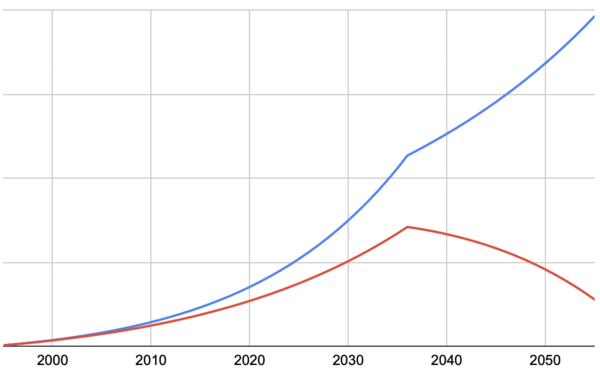
It was a line graph. The x-axis went from 1995 to 2055 or age 25 to 85. The y-value was my predicted net-worth. This was the result of using my expected salary growth, my savings rate, expense growth, my current net worth, inflation guesses, expected return, etc. You can find many such calculators on the web or do it yourself in Excel.

It was as you would imagine, an exponential growth curve that results from compound interest as long as returns and savings grow with respect to expenses and inflation.

The part that surprised me was that at 2035, when I would turn 65 and presumably retire, the curve had a noticeable notch, but still basically grew, but on a different exponential curve.

I asked how it could still go up after I retire, and he explained that at that point my investments would make more each year than I needed to spend, so they would keep growing.

I recreated the shape here.

In my mind, the red line was what I was going for—it’s not a bad outcome. He showed me that the blue line was not only possible, but actually, I was already headed there if I kept my savings rate. Most of the assumptions were fairly conservative. The only difference between those lines is expense growth (or, in other words, savings growth).

I honestly didn’t hear anything else he said that day. Look at what a difference it makes.

Assuming that you are not a stock-picking genius (spoiler alert: you’re not), and you are getting market returns from index funds, the only variable you control is savings rate. Of course, there are several components of savings rate, which I’ll talk about soon.

April Blog Roundup

This month I realized that this blog is easier to keep up with if I just document my projects. I released episodes 4, 5, 6, and 7 of my podcast about writing. I also wrote articles about how I am self-hosting it, using S3 for the media, and how I get simple stats.

I also wrote an article about Bicycle, an open-source library I am working on with a couple of friends, and I’ve been writing articles about WatchKit on App-o-Mat. And this post itself is an example of just documenting my projects.

Most of the articles I write for this space are about software development and processes.

  • In Defense of Tech Debt encourages you to just think of tech debt as a cost which might be acceptable.
  • But, I think Tech Debt Happens to You most of the time because of dependencies.
  • And then in Timing Your Tech Debt Payments, I compare payments to servicing interest and paying down principal and offer a best time to do the latter.
  • In It’s Bad, Now What?, I talk about pre-planning actions for when monitoring shows problems
  • In Assume the Failure, I recommend framing all risks as your own failures, not external ones, so that you can personally mitigate them.
  • In Mitigating the Mitigations, I show how you can’t wait until a risk materializes to do your mitigation plan. It might be something you need to do somewhat in parallel.

And, I wrote some articles on gaining expertise

I have been thinking about the great works in software and software writing as I think about where I want to spend my time. I think there’s an interesting cycle of making -> tool making -> making with the tool, where the result is content in a new medium.

Reframing Anxiety

Caveat: This works for me, and I am talking about it in the hope that it can help others. It’s not for everyone.

Over the course of my life I have become a lot better at managing anxiety. I once joked that all I had to do was realize that there’s no logical reason to feel anxious and then wait twenty-five years to see that I was right. That pretty much sums up how I’ve managed it.

Recently, though, I’ve come to see anxiety as as asset.

In my career, I would say that I generally get big things done by being on top of them. By worrying about them. I think about mitigations, like you’re supposed to, but even mitigating the mitigations. It’s probably a bit much, but it works for me. I think of this as being conscientious.

And that’s the reframing that’s helped. My feelings of anxiousness are a flip-side to conscientiousness. They come together. So, to the extent that I am happy about my approach to work, I have to accept that I will often feel unfounded anxiety.

I have come to be thankful for it. When I feel it coming on in an unwelcome way, I tell myself that this part of me is helpful at other times, and it can assuage it.

Review: How to Make Feeling Good Your Priority

My running coach, Holly, published a book last month called How to Make Feeling Good a Priority [amazon affiliate link]. The book is part advice and part memoir (as she learns and applies her advice to herself and clients). I am lucky to be a client and have heard much of this from her, but having it all in one place helped me see how it wasn’t just for running.

Holly is a serial marathoner (27 so far) and I have done two under her coaching (and training for a third). We often talk about how to make adjustments during training and during a race to prioritize feeling good. This book is about doing that outside of running—a connection I didn’t make.

There are many lessons, but the one that stuck with me is turning “I can’t” into “How can I?”. I have written about habit triggers before—how you can control your own behavior, in part, by controlling the triggers that prompt that behavior. Anchoring a problem-solving mindset to “I can’t” comes up surprisingly often.

So much of the book is about shrinking the impact of bad feelings and increasing the effect of good ones. There are a lot of actionable tips and strategies.

I can’t say that I related to everything, but a lot of it resonated with me. Her chapter on the Law of Attraction (which always seemed like mysticism to me) resonated with my beliefs about tapping into randomness. I have come to see “attraction” as “focussing”/”awareness”—I don’t think you attracted the thing you wanted, but I do think you were more likely to notice it. And mentioning it to others helps them notice it for you too.

Knowing Holly, I see her personality on the page. She’s a positive person, always trying to find ways to solve the issues I bring up with her. Under her training, I have very rarely missed a workout and I haven’t had an injury—the rest takes care of itself. After reading her book, I do think that her concept of the “runner’s mindset” can be applied to the rest of my life too.

I Didn’t Have a Disk Drive

When I was 13, my mom got me an electric typewriter for Christmas. Luckily, it was broken, so we went back to Radio Shack to return it. When we got there, they were trying to move TRS-80 Color Computers for about $50 (the same price as the typewriter).

So my mom got me a 4k, chiclet keyboard version that hooked up to a TV. There was no storage included, but supposedly you could hook them up to ordinary tape recorders (I never figured this out).

The next Christmas, I got a Commodore 64, again with no disk drive. I finally got a disk drive for my birthday a few months later.

For a while, my home computer could literally do nothing except be programmed.

All of my personal programs lived on paper. I typed them in, played with them a bit, and then re-transcribed them back to paper. My most ambitious program in this time period was a very light Defender clone made from ASCII art.

It was like learning a musical instrument.

If I were learning piano, I would play songs over and over until I got them right. If I could compose music, I’d do it on paper and retranscribe often.

And doing this did at least accomplish the goal my mom had with her original gift. I learned how to type pretty fast.

Sponsor, Don’t Mentor

Since I mostly use Twitter to listen to young, underrepresented programmers, I get to hear about things I normally would not. One recurring theme is the role of mentors, and at some point I saw people talking about how they needed sponsors instead. Here’s an example from Nancy Wang in Forbes:

Part of a solution could be via mentorships and sponsors. The difference is critical: mentors can help make introductions and give valuable advice, and sponsors often go one step (or many steps) further, leveraging their own reputation and personal capital to advocate for your success.

I am trying to apply this when people ask for advice. It’s hard.

It’s easy to just say a bunch of stuff. Talk about yourself, tell a story, recommend a book, etc. If you are successful, it’s easy to think it’s because of the things you did and if someone else did them, they would also be successful. But it’s not that simple, because mixed in with our efforts were luck and helping hands. A lot of what we think is good advice doesn’t apply at the very start, where we need someone to just take a chance on us.

When I look back for sponsors in my own life, I remember that my aunt got me a job filing paper invoices in her office and that’s where I learned Lotus 123 and did my first professional programming in high school. At 13 my mom got me a computer at Radio Shack when we went there to return a defective electric typewriter (they were the same price). A few months before that, my wood shop teacher transferred me to computer “shop”. They didn’t give advice—they used their “personal capital” to put me in a position to grow.

Moms, aunts, and teachers will probably always help out a teenager. They are part of our lives, know us well, and probably feel a vested interest in our success. But, as aspiring sponsors, we can do that too. Our goal should be to get to know the people we are trying to help. To become invested in their success.

So, now when someone approaches me for help, my default is to think about how I can get into a position to sponsor them. To do that, I need to know them and what they can do. For programming students, I hire them to help me with my personal projects and consulting. I always pay for this work.

It’s not a lot, but my goal is to get to know them well enough to recommend them without reservation.

Twitter Can be an Empathy Machine

Update July 2023: This post was written in 2021. Since then, I have changed my views on Twitter and deleted all of the data in my account. I haven’t edited this post, but I would see it as more of a way to use Mastodon or other social media, not Twitter specifically.

I don’t tweet much, so my Twitter experience is highly dependent on how I manage who I follow, block, and mute. I realized a few years ago that by tightly controlling this, I could make Twitter into any experience I wanted.

I decided that the best way to use it for me was to give me access to voices I wouldn’t normally hear from. So (aside from people I know in real life), I almost exclusively follow programmers from groups that are underrepresented in tech.

In my feed, since they are way overrepresented, I am constantly exposed to the world as they experience it, and it helps me develop empathy. I can feel my attitudes and default reaction changing in ways it never would have if I only interacted with people I know.

Another important part of how I use it is that I mostly listen. If the topic is tech and I can answer a question or add value, I do. But I don’t chime in on topics where I should be learning, and where my instincts are probably not great.

I can also add value by amplifying their great work. Again, by making my default overwhelmingly underrepresented programmers, it’s just more likely I will be exposed to their work instead of it getting buried in my feed.

February 2021 Blog Review

This month I talked about how The Practice helped me understand what I am trying to do by blogging and motivated me to blog every day. I shared some tips to how I am doing that.

  1. Start the day by writing morning pages, then write a shitty first draft.
  2. Keep a long list of topics.
  3. Bank blog posts.
  4. Edit by using the editing sweep method.
  5. Write a lot of posts to become a better writer.
  6. Generate topics with these tips. For example: Mining your tweets or writing while reading.
  7. Use media depravation to make space in your brain for your own ideas.

I offered some tips for technical job seekers.

  1. Write a job statement
  2. Build your network by being useful to people
  3. Don’t be afraid of rejection.
  4. Make your resumé specific to the job.
  5. Prepare for interviews like they were a performance.

January 2021 Blog Review

Last month, I wrote mostly about how we can apply game design to books and apps. By this, I mean making the book or app literally a game (like Pokémon Go), not slapping on badges to gamify an app. Speaking of Pokémon Go, I have ideas for how AR will turn mundane apps into games.

I also covered parts of my daily and weekly routine, and how I use habit totems to keep myself on track.

I wrote a little about programming. I think tutorials should be vaguer because they would force learners to write programs, not read them. If they were, they would be better preparation for coding interviews. I updated my 2011 advice on GitHub profiles. I covered two approaches to app icon design, icon-first and icon-last.

In February, I plan to talk more about my practice of daily coding, writing, and sketching.