Continuing on the subject of Forever Goals and Infinite Games, let’s compare them to habits.
As a reminder, an Infinite Game is one you play so that you can play it. It is intrinsically fun. The goal, if there even is one, is to get better so that you can keep playing. A Forever Goal is something you will always want, but can’t really achieve. You approach a Forever Goal. Asymptotically. Over infinite time. I think there’s a connection.
Since you can only approach a Forever Goal with constant work, I think designing an infinite game that incidentally gets you closer is a good strategy. Habits can also work, but for different reasons.
Habits aren’t designed to be fun. An infinite game is more like a bad habit. They’re both addictive. Good habits usually aren’t. BJ Fogg, author of Tiny Habits [ad], says to design habits that are so small that you will still do them even when you aren’t motivated. They need to be easy because they’re not fun.
Infinite games, however, are fun. They are designed to be their own motivation. You would play even if you had no extrinsic goal. The goal of the game is to keep playing the game. Habits aren’t like this. They are a means to an end. If you don’t want the end or the habit doesn’t work, you’ll stop.
The benefit of a game over a habit is that it can be more complex and take more time and energy. Tiny Habits are supposed to lead to bigger actions, but they rely on motivation. If you do a habit and you happen to have a lot of energy for the activity, then you could extend it (e.g.: a tiny habit of flossing one tooth could lead to flossing all of your teeth). But you don’t need motivation to keep playing a fun game. You need motivation to stop. When you put more time and energy into something, even as it gets more complex, you get better faster.
Another difference is that habits get easier over time, but infinite games get harder. It’s even more important that it gets more fun the better you are at it. A game shouldn’t be easy to master. Mastery might take forever. And the rewards should increase with your skill. If not, it gets boring and you will quit. When the game’s difficulty is achievable and the outcome is rewarding, you don’t need motivation to play it.
Applying this to my life, I use a combination of habits and games. My morning routine is mostly built on habits: taking vitamins, flossing, etc. Backed by reminders and environmental cues. But, my fitness is almost completely game-based. I don’t need any motivation because I just want to play, sometimes to my detriment (like a bad habit) as I nurse injuries.
And this all brings me back to learning Spanish, which I still force myself to do, and not very well. Still not a game and not even a consistent habit.
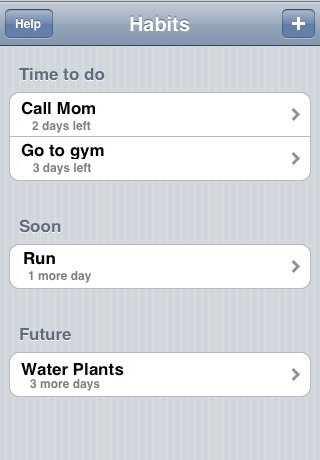
 A couple of weeks ago, I decided to refresh its look in anticipation of iOS 7. Unfortunately, an app compiled with iOS 6 doesn’t automatically pick up the new look — at the very least, you need to recompile. Instead, I decided to design something custom that would look good now and feel at home on iOS 7. While I was at it, I updated the icon using the iOS 7 app icon grid.