This is part of a series called Eight Questions to Ask About Your Tech Debt
- Introduction
- #1: Visibility, #2: Misalignment, #3: Size, #4: Difficulty, #5: Volatility, #6: Resistance, #7: Regressions, #8: Uncertainty
- Using the Eight Questions
- Planning with the Eight Questions, Part 1, Part 2, & Negative Net Force Projects
- Bonus Question #9: Joy
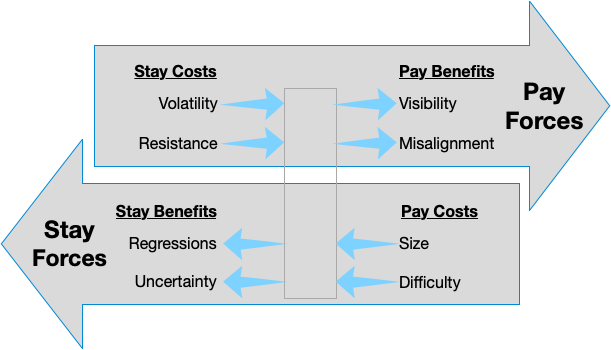
The main thing to keep in mind is this diagram (described in the introduction):
Now that we know the eight questions and how they work to help us decide on plans, the next thing to tackle is When Do We Answer the Eight Questions?
In Swimming in Tech Debt, I argue that you should establish a tech debt backlog (separate from the one you use to manage work) and that your team should meet quarterly to plan and approve work. To start, I propose you schedule a kickoff and a kickoff follow-up meeting a week later. This is where the team can build the backlog and make plans.
Use the eight questions to drive the agenda
The eight questions give a sense of each item’s priority with its Net Force (the difference between the Pay Force and the Stay Force in the diagram above). I would also prioritize anything with a high Pay Force, even if it is offset, because we can start by reducing the Stay Forces. I described this in the Negative Net Force Projects article in this series.
Then, as you consider each item, you can use your answers to the questions as a guide for what to do.
Finally, in each quarterly tech debt meeting, you might need to re-ask the questions. A lot of the work you have done might be to reduce stay forces (e.g. with spikes), increase pay forces (e.g. with a documented target architecture), or score more accurately (e.g. by building a dashboard).
Your PM will also be updating the feature roadmap, so you have more clarity on where Volatility will increase. There are probably new items to discuss as well.
In Part 3 of Swimming in Tech Debt, I go over each of these meetings in depth and there are sample agendas in the Appendix. Get in touch if you would like help facilitating these meetings.