In the 90’s, I read a book about fuzzy logic that would feel quaint now in our LLM-backed AI world. The hype wasn’t as big, but the claims were similar. Fuzzy logic would bring human-like products because it mapped to how humans thought.
Fuzzy Logic is relatively simple. The general idea is to replace True and False from Boolean logic with a real number between 1 (absolutely true) and 0 (absolutely false). We think of these values more like a probability of certainty.
Then, we define operations that map to AND, OR, and NOT. Generally, you’d want ones that act like their Boolean versions for the absolute cases, so that if you set your values to 1 and 0, the Fuzzy logic gates would act Boolean. You often see min(x, y) for AND and max(x, y) for OR (which behave this way). The NOT operator is just: fuzzy_not(x) => 1.0 - x.
If you want to see a game built with this logic, I wrote an article on fuzzy logic for Smashing Magazine a few years ago that showed how to do this with iOS’s fuzzy logic libraries in GameplayKit.
I thought of this today because I’m building a tool to help with decision making about technical debt, and I’m skeptical about LLM’s because I’m worried about their non-determinism. I think they’ll be fine, but this problem is actually simpler.
Here’s an example. In my book I present this diagram:
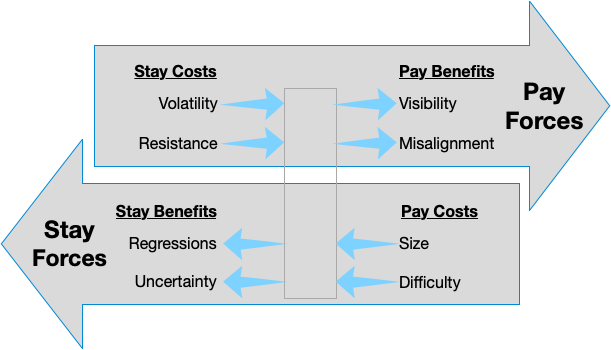
The basic idea is to score each of those items and then use those scores to make a plan (Sign up to get emails about how to score and use these forces for tech debt).
For example, one rule in my book is that if a tech debt item has high visibility (i.e. customers value it), but is low in the other forces that indicate it should be paid (i.e. low volatility, resistance, and misalignment), but has some force indicating that it should not be paid (i.e. any of the stay forces), then this might just be a regular feature request and not really tech debt. The plan should be to put it on the regular feature backlog for your PM to decide about.
A boolean logic version of this could be:
is_feature = visible && !misaligned && !volatile && !resistant &&
              (regressions || big_size || difficult || uncertain)
But if you did this, you have to pick some threshold for each value. For example, on a scale of 0-5, a visible tech debt item be one with a 4 or 5. But, that’s not exactly right because even an item scored as a 3 for visibility should be treated this way depending on the specific scores it got in the other values. You could definitely write a more complex logical expression that took this all into account, but it would hard to understand and tune.
This is where fuzzy logic (or some kind of probabilistic approach works well). Unlike LLMs though, this approach is deterministic, which allows for easier testing and tuning (not to mention, it’s free).
To do it, you replace the operators with their fuzzy equivalents and normalize the scores on a 0.0-1.0 scale. In the end, instead of is_feature, you more get a probability of whether this recommendation is appropriate. If you build up a rules engine with a lot of these, you could use the probability to sort the responses.
Fuzzy logic also allows you to play with the normalization and gates to accentuate some of the values over others (for tuning). You could do this with thresholds in the boolean version, but with fuzzy logic you end up with simpler code and smoother response curves.